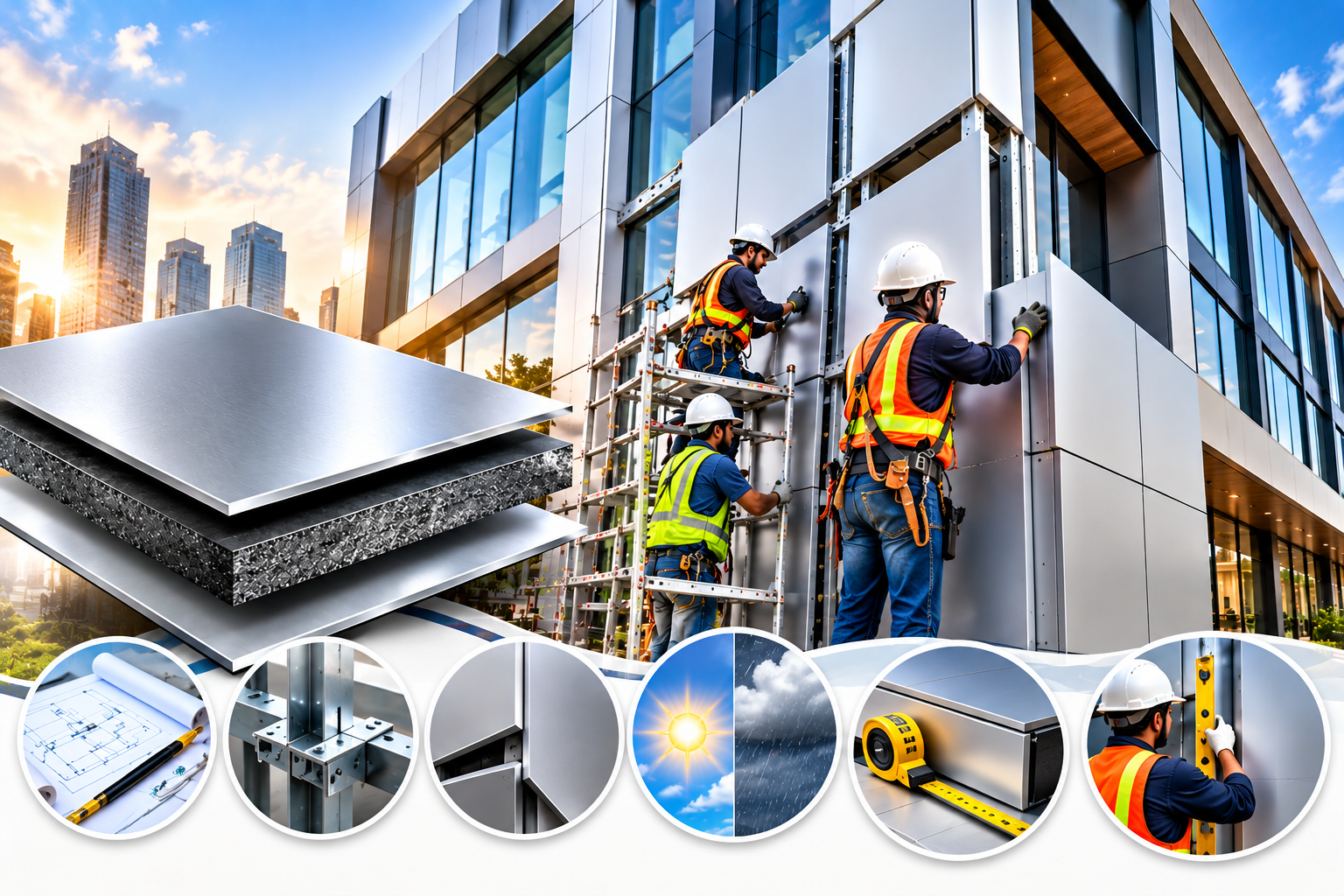
Architectural cladding can transform the appearance of a building, but successful results depend on careful decisions throughout design and construction. Small mistakes in panel layout, attachment details, or material specification may lead to visible defects and unnecessary maintenance challenges.
When planning facades with acm exterior panels, understanding common design problems helps project teams develop more reliable solutions.
Preventing these issues begins with coordination between architectural intent and technical requirements.
Mistake 1: Selecting Panels Based Only on Appearance
Color, texture, and surface finish are important architectural considerations.
However, visual appeal should not be the only selection criterion.
ACM exterior panels must also satisfy applicable structural, fire-safety, and environmental requirements.
How to Avoid This Problem
Review the relevant technical specifications before approving a material.
Confirm core composition, panel dimensions, finish suitability, and required compliance documentation.
Material selection should reflect the complete building assembly.
Mistake 2: Ignoring Thermal Movement
Exterior aluminum surfaces experience dimensional changes as temperatures rise and fall.
If panel joints or attachments restrict this movement, the facade may develop unnecessary stress.
ACM exterior panels require suitable allowances based on their dimensions and installation configuration.
Better Design Practice
Establish movement requirements during engineering design.
Coordinate joint widths and connection details with the expected temperature range.
Installation teams should follow the approved arrangement without introducing unverified changes.
Mistake 3: Using Inappropriate Panel Dimensions
Large panels can create attractive architectural surfaces.
Nevertheless, dimensions must remain compatible with the material’s mechanical characteristics and supporting structure.
Oversized ACM exterior panels may require additional support or different engineering solutions.
Finding the Right Balance
Evaluate panel dimensions alongside wind loads, support spacing, fabrication limitations, and architectural proportions.
A carefully coordinated layout can achieve visual consistency while maintaining practical construction requirements.
Mistake 4: Overlooking Moisture Management
A visually complete facade does not necessarily provide a fully weather-resistant wall.
Water can enter certain cladding assemblies through joints or around openings.
ACM exterior panels must therefore be coordinated with the building’s moisture-management strategy.
Focus on Vulnerable Areas
Windows, doors, corners, and material transitions require particular attention.
Appropriate flashings, drainage paths, and water-resistant barriers help protect the underlying construction.
The details should reflect the selected wall-system design.
Mistake 5: Neglecting Supporting Structure Alignment
Even accurately fabricated panels can appear uneven when installed over an incorrectly positioned subframe.
Misalignment may become especially noticeable across broad exterior elevations.
ACM exterior panels should be installed on supporting components positioned according to approved drawings.
Improve Installation Accuracy
Verify structural interfaces and subframe geometry before panel placement.
Use established reference points to maintain consistent alignment.
Quality checks should continue throughout installation.
Mistake 6: Forgetting Future Maintenance
Facade design should consider what happens after construction.
Some surfaces may be difficult to access for cleaning or inspection.
Without suitable maintenance planning, minor issues can remain unnoticed.
ACM exterior panels should be incorporated into a realistic building-maintenance strategy.
Plan for Long-Term Care
Consider inspection access, environmental exposure, cleaning methods, and replacement procedures.
Maintenance recommendations should match the selected panel finish and installation system.
Mistake 7: Poor Coordination Between Project Teams
Architectural drawings, engineering requirements, fabrication details, and installation procedures must remain consistent.
When teams work from conflicting information, errors can affect both appearance and performance.
Clear documentation and timely technical reviews help reduce these risks.
Conclusion
Avoiding common facade mistakes requires more than careful panel selection. ACM exterior panels must be supported by appropriate engineering, accurate installation, effective moisture management, and a realistic maintenance plan. Thermal movement, panel dimensions, attachment details, and regulatory compliance should all be addressed before construction begins. Strong coordination between project teams helps prevent avoidable defects and preserves the intended architectural appearance. With disciplined planning and execution, composite cladding can contribute to building exteriors that are visually consistent, functional, and dependable.